
My Love of German Wine
Wine is Life
“In my opinion there are many parallels between our lives as human beings and the evolution of good wine.”
Historically, German wines always enjoyed a great reputation. At the turn of the 19th to 20th century, single vineyard wines from the Mosel and the Rheingau were prized higher than the wines from Bordeaux and Champagne. Every major hotel and restaurant around the world made sure they always carried wines from these German regions on their lists. The charge was led by the great Riesling wines from the top vineyard sites.
In my role as Product Development Manager at Langguth, one of the leading branded wineries in Germany at the time, I was also in charge of the marketing activities. This was in the late nineties at a time when the blockbuster movie Titanic hit the screens. We were contacted by an English historian who came across a copy of a wine list that included two Mosel wines from Langguth. Exciting stuff.
During the 20th century, the reputation and the general quality of German wines declined due to mass production and the exportation of cheaper, sweeter wines. The great vineyards of the Mosel and Rheingau never stopped producing great wines.
A shift occurred in the 1990’s with a new generation of growers realizing that Germany’s wine future will be driven by the return to the more exclusive, quality-oriented niche character of German wines. This included a switch to sustainable, organic, and biodynamic farming principles, recognizing that the quality of the wine is first determined in the vineyard. Once again, Riesling played a leading role. During the era of quantity over quality, Müller-Thurgau, the main variety found in wines like Liebfraumilch, had overtaken Riesling as the most widely planted grape variety in German vineyards.
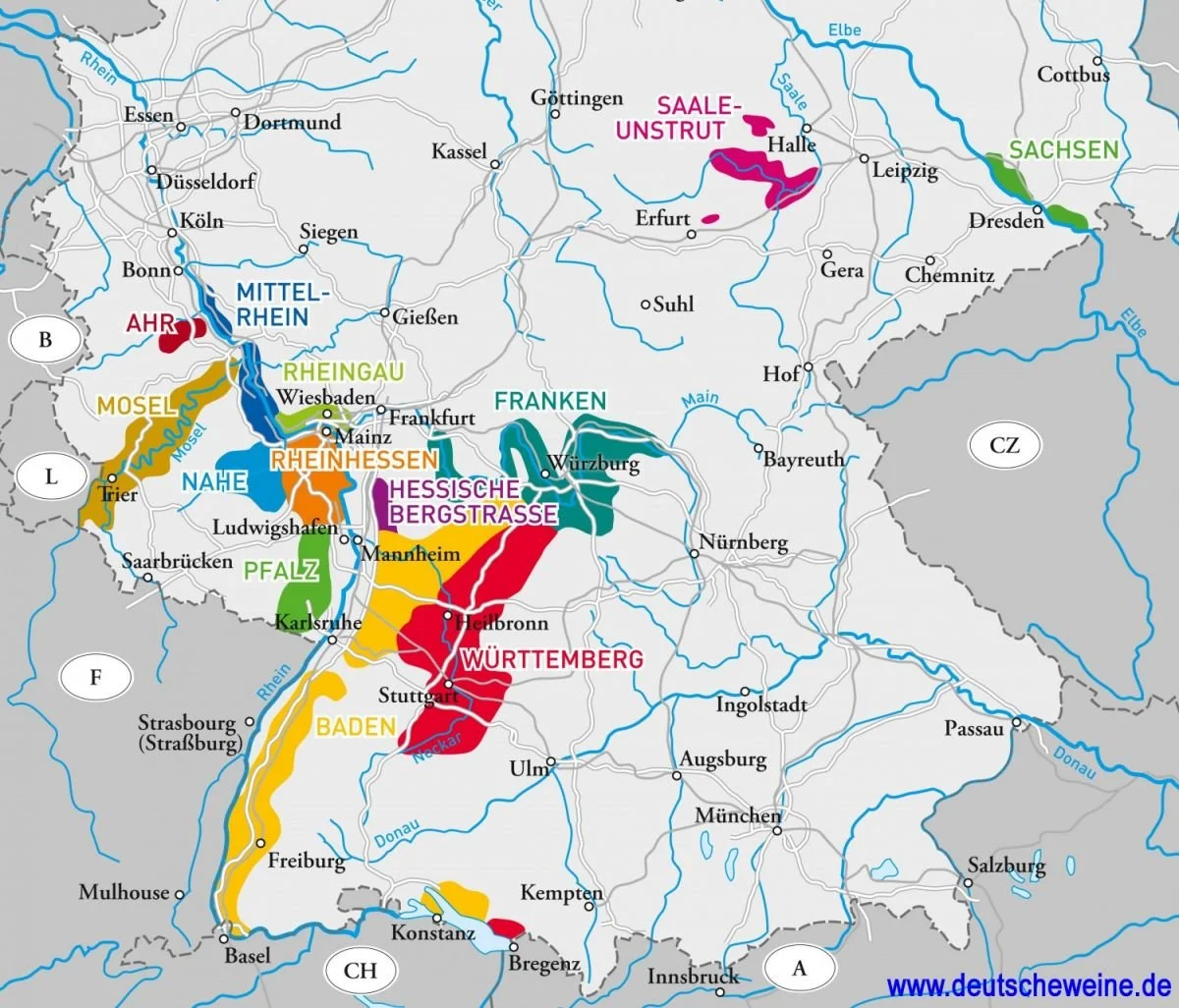
Now Riesling has reclaimed its leading spot. In 8 of the 13 wine regions in Germany, Riesling is once again the most widely planted grape. Three of the remaining five regions are very small and play only a minor role in German wine production. The other two regions, Baden and Franken, produce significant volume, but they focus on producing outstanding Pinot wines, Pinot Noir, Pinot Blanc, Pinot Gris, and Chardonnay, (Baden, and there specifically the Kaiserstuhl region) and Silvaner in Franken.
Following is a link to a YouTube commentary of Hugh Johnson, with additional commentary of Jancis Robinson, which sums up very well the advances made by the VDP. The new initiative by the VDP started in 1994, and Hugh Johnson played a major role in its strategic direction. I was privileged to participate in an event titled “French food and German wine” that took representatives of the various business models in the German wine industry on a tour to some of the great estates in Bordeaux.
The last evening was hosted by Hugh Johnson as the MC, and I remember vividly the inspiring conversations we had on this topic. I am happy that I was able to attend in the company of some icons of the German wine world, such as Egon Müller. It was there that I first met Wolf-Dieter Salwey, Konrad’s father, who was the first member of the VDP from the Baden region.
https://www.youtube.com/watch?v=L4HS1Yf_n6Q
Riesling wines are very nuanced and are fantastic companions to any meal. They offer a diverse style, depending on the vision of the grower and the soil conditions in their vineyards. There is certainly something to please everyone’s taste preferences. Leading wine experts and educators like Jancis Robinson cite Riesling as their favourite white wine.
The Pinot wines from Konrad Salwey in the Kaiserstuhl offer different dimensions. Almost Burgundian in style, they are more full-bodied while still displaying the elegance that German wines have become appreciated for around the globe. The Kaiserstuhl region in Baden and the Mosel region are very close to our family’s hearts. Our son is born in the Kaiserstuhl, and our daughter in the Mosel region. We have very special and fond memories of both regions, especially when we get to enjoy a great Pinot from Salwey, or the elegance of a Riesling from Dr. Hermann.